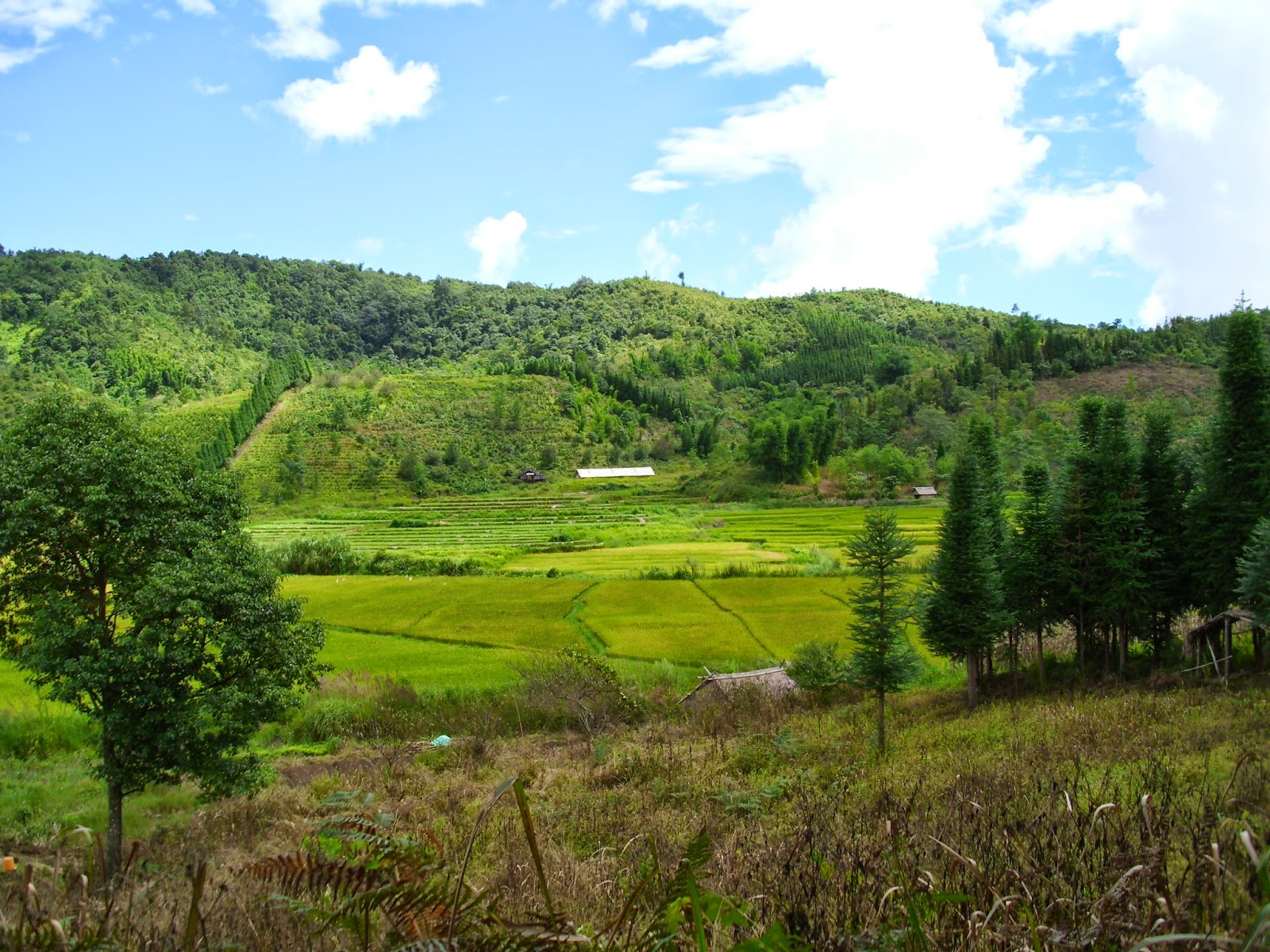
Dear reader,
It's been a while I haven't posted here. Maybe I have stopped writing about tea because I am too busy learning. I have graduated and now live with my wife, Yubai, in Yunnan.
We spend a lot of time in Jingmai mountain, making tea, experimenting, enjoying a life of dedication to the leaf. I love this new life, full of excitement and filled with adventure.
We have just opened a new website, to promote our Pu-erh tea productions and other Yunnan teas we like. In the last weeks, I have tried to put all the knowledge I've acquired in the last years on paper. I have written new articles that are available in the product descriptions of our new website. From now on, I will try this new format, every time I will post a new product; I will write an article related to it.
We will keep Bannacha running because many European tea enthusiasts like it. We will update it with new products, even though the offer will not be as extensive as on the new website. We would like to improve its functionality and the general user experience. Do you think this old website needs a redesign? Any suggestion is welcome.
You can now visit Farmerleaf, enjoy!
Bannablog is dedicated to tea production in Yunnan, south western China. You can find more information about Pu-erh tea on this website: articles.bannacha.com I hope you will enjoy the reading, you are welcome to post comments.
Thursday, October 27, 2016
Wednesday, April 15, 2015
What defines a tea?
There are
hundreds of different names for tea : Darjeeling muscatel, Bi Luo Chun,
Tie Guan Yin, Hojicha, Pu-erh, Bai Mu
Dan, Tai Ping Hou Kui, Dong Ding, Dong Fang Mei Ren, Gyokuro, etc…
Just like
the classification of European wines, this system requires a lot of knowledge;
you have to learn about the specifications of each tea one by one.
I would
like to give a simpler approach to tea. By focusing on the aspects which have
the most influence on the taste of tea, you will be able to have a rough idea
of what the tea will taste like just by looking at the leaves.
| Early Spring 2014 Jingmai tea |
First, let’s
start with things that are not obvious to see: the cultivar. Apart from Pu-erh
tea, most of the teas come from selected tea trees. For example, Tie Guan Yin
comes from a specific cultivar, its processing is the same as many Taiwanese
high mountain teas. Tea trees are mostly selected for the taste of their
leaves, and to a minor extent for their capacity to resist certain disease or
cope with frost.
There are
two main varietals: sinensis and assamica, also called China and Assam or big
and small leaf varietal. Generally speaking, var sinensis has small leaves, a
low yield, a better resistance to low temperatures and more fragrant leaves
than var assamica, which is a more robust varietal. Their main botanical
difference is that sinensis is a shrub: it grows many small branches from the
ground, assamica is a tree, it grows a single trunk and grows taller. The
difference in leaf size can be confusing because there is a middle ground where
leaves could come either from sinensis or assamica. There are also wild
varietals such as Camellia taliensis in South East Asia or Camellia formonensis
in Taiwan.
| China varietal in Pandam Tea Estate, Darjeeling |
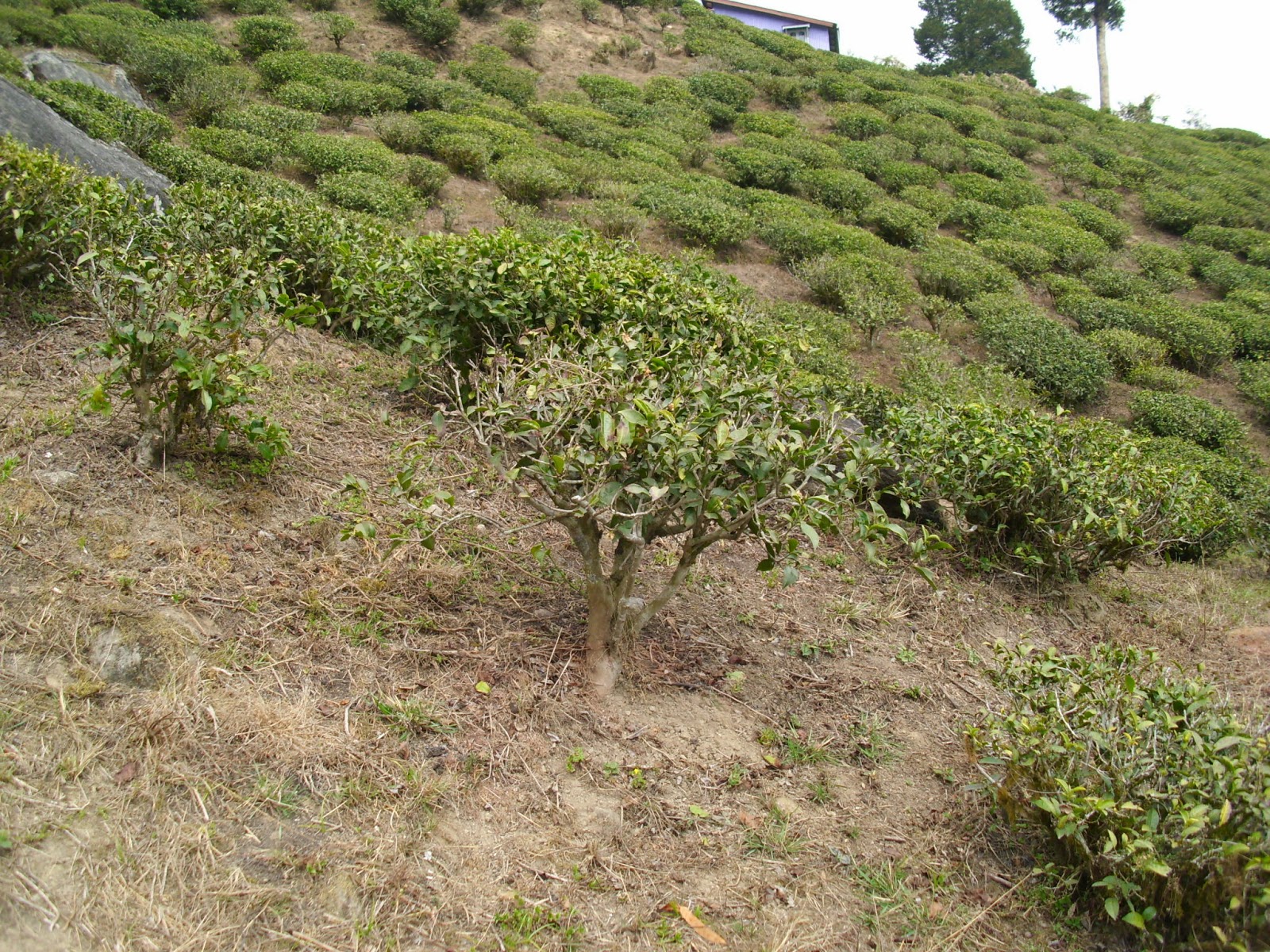
| Assam varietal in Pandam Tea Estate, Darjeeling |
The harvest
time, altitude and agricultural techniques have influence on the strength of
tea because the tea leaves will make different amounts and types of chemical
compounds according to the environment conditions: temperature, sunlight, nutrient and water availability, presence of
some insects…
Finally, the
leaf grade has a big influence on the tea quality. More buds give lighter and
more fragrant tea, while older leaves give a stronger brew with more bitterness
and astringency. Tea with lots of buds is more expensive because it takes more
time to pick, but it’s not necessarily the tea you’ll like most, some people,
including me, prefer 1 bud/2 leaves tea over single buds or 1bud/1 leaf. A high
amount of tea stalks makes tea sweeter.
A good tea
starts in the field, but its quality is glorified in the factory, the large
variety of taste is obtained thanks to many different processing techniques.
However, those techniques have an impact on a couple of factors only, which I’m
going to detail now.
The oxidation
state might remind you of your worst cramming time at university, trying to
understand organic chemistry. Tea has many polyphenols, which are (in)famous
for having many possible oxidation states. Simply put, the more oxygen atoms attached
to a molecule, the more oxidized it is (dear chemist readers, I’m sorry for taking
such shortcuts!). The more oxidized a tea, the darker it is, note that most of
the teas being black, green or wulong, they are solely differentiated by their
oxidation state. I’m not going to go
into further details on what happens in the leaves, but oxidation state of tea
can be influenced by heat treatment (pan frying or steaming) and aging
(especially in Pu-erh teas and white tea).
| Experimenting with oxidation |
Roasting is
another way to make a tea darker and enrich its flavor profile. Just like
coffee, some teas are roasted, a chemical reaction occurs and the leaves get
darker, this is the same process that makes meat turn dark when you cook it, it
is called the Maillard reaction. Roasted tea leaves have a hard time unfolding
when they are brewed, this is because the leaf cells are damaged during the
process and probably stick together. It also brings out more astringency
because as some cells burst, more chemical compounds will be released during
the steeping.
Most of the
teas are rolled, some of them so heavily that the leaves are broken during the
process, just like many Darjeeling teas. During the rolling process, the cell
walls are broken; just like roasting, this allows more chemical compounds to be
released during the brew. Heavily rolled teas pack a punch in the first brews but
struggle after a couple of infusions. They tend to be more bitter and astringent;
this is what gives “briskness” to the Indian teas.
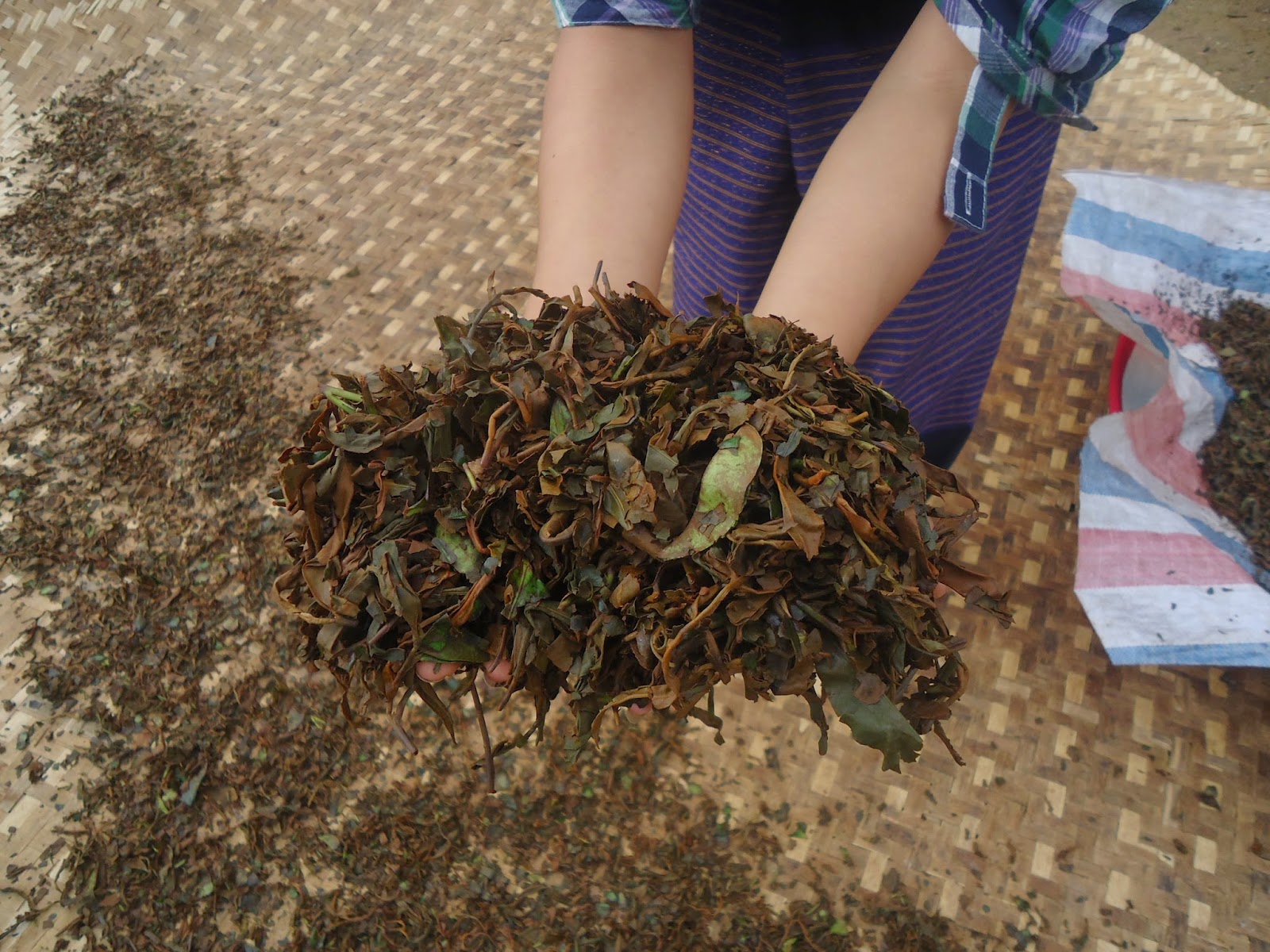
| Heavily rolled tea |
Finally,
tea can have added flavor, wanted or not. Smokiness or off-flavors are
generally considered as flaws but can be desirable traits. Mixing fragrant
flowers such as jasmine is a traditional way to bring more fragrance to the tea
leaves. More modern techniques involve the spraying of artificial flavors or
essential oils.
To
summarize, if you want to know what kind of tea you’re dealing with, try to
know which cultivar it comes from, in which conditions it was grown, when it
was harvested, look at how dark the leaves are, check if the leaves seem
roasted, oxidated, heavily rolled or broken. And more importantly, enjoy your
tea session.
Tea makers
don’t see each tea categories as independent. In the field and factory, you can
virtually make an infinite number of different teas because you can always do
something more or less: weathering, rolling, frying, roasting, drying… These
are slides, not switches. Knowing this, debating about whether Darjeeling tea
is black or wulong tea then becomes irrelevant. A name is only an approximation;
the real thing is what you get in the cup.
Sunday, March 29, 2015
Organic matter
In my last
post, I talked about the importance of a good soil structure for having a high
fertility. Another very important factor is the percentage of organic matter
present in your soil.
Organic
matter is essentially made of carbon, the atom that defines life. Carbon is the
basic unit of all living things, from bacteria to humans. As Antoine Lavoisier
said: “in Nature, nothing is created, nothing is lost, everything is
transformed”. I’m going to talk about
the fate carbon and why it matters in agriculture.
| A diverse landscape in Mengsong, Xishuangbanna, Yunnan. |
When the
leaves fall off the trees, they accumulate on the ground and for litter. After a while, the action of
small animals, fungi and bacteria will transform the litter in humus: a dark material made of
unrecognizable remnants of leaves, dead microorganisms and animal feces (yes,
you’re walking on poo every day!). The difference between humus and litter is
the stage of decay at which they are, but the limit is not very clear.
Litter is organic
matter which is being eaten by microorganisms, it is transforming, typically
the colorful fallen leaves cover that you can see in the forests during Autumn.
Litter is the main source of food for the soil animals and microorganisms. Worms
feed on litter, their presence in the soil will guarantee a good soil structure
because they spend their life digging tunnels. They eat litter and digest it
into smaller particles. Nematodes are very tiny round worms, barely noticeable
with the naked eye, they will continue the job and eat smaller pieces. Fungi
and bacteria eventually degrade organic matter into humus.
| Jingmai Ancient Tea Gardens have a thick litter thanks to the big trees. |
Humus is organic
matter that has reached its final stage of decay, it is almost as stable as
stone, it is what’s left after microorganisms have eaten everything. Humus
mixes with the soil particles (sand, silt and clay), this is what makes your
soil more or less dark. It is important
to have a lot of organic matter in the soil because it increases the water and
nutrients capacity of the soil, the fridge is bigger!
Not only
the fridge gets bigger as humus is produced, but it is also steadily filled. If
organic matter is mostly made of carbon, it also contains nutrients very useful
for the plants: nitrogen, phosphorus, potassium, magnesium, calcium… It works
as if you were demolishing a house: you couldn’t reuse the concrete, but you
could recycle the copper from your electric wires and use it in a new house.
Nature works the same, as matter decays, nutrients are made available to the
plants.
| The soil in Jingmai has a dark color, it is rich in organic matter. |
Chemical
fertilizers are very handy for the farmers because they are much lighter than
organic manure, you need to add up to a hundred times less of for the same
amount of nutrients. This is one of the main reasons why they are widely used
in the world, from large scale industrial farms to smallholders who don’t have
a tractor. They have been the cornerstone of the Green Revolution.
However, their
use on the long term creates a major problem: soil degradation. A soil is
always degraded because of rain, wind and chemical processes. In order to
compensate the losses, you have to continuously add things; this is especially
true when it comes to organic matter. After several years without adding
organic matter, the soil structure is impacted; it is more vulnerable to
weathering and has poorer nutrient and water retention capacity. In other
words, you have plenty of food, but your fridge is very small…
Wednesday, March 25, 2015
For a fertile soil...
For a
long time, soil has been seen as a simple support. The philosophy of conventional agriculture is to give each
problem its solution: if there isn't enough nutrient, you add
fertilizer, if there isn't enough water, you add irrigation and if
there's a pest attack, you spray pesticides. In conventional farming,
the soil is adapted to the crop by using a variety of inputs.
Agroceology
takes a different approach. The soil is the most important part of the
field because many ecological processes occur in it. Changing your
agricultural practices will affect those natural processes which will
change your soil and create a positive or negative dynamics.
Conventional agriculture focuses on the present and neglects those
long-term evolutions, this is why soil degradation occurs in many
place: because of a poor management of the ecological processes, the
soil was kept in a vicious circle for years. The yield was not
affected because the loss in soil quality was compensated by extra
inputs added. Farming on a degraded soil is possible but it requires
an intensive management because everything has to be brought.
| Irrigated and heavily pruned tea trees |
A
good soil can store nutrients and water, the main things plants need
to grow. One of our teacher says "soil is to water what the
fridge in your house is to you, and you prefer it big and full of
good stuff". Some soils are better than others naturally,
because of their texture. Soil has particles of different size, from
big chunks of sand to tiny pieces of clay. The smaller the particles,
the better the soil can keep things in it, therefore, a clay soil is
generally preferred to a sandy soil. The soil texture cannot be
changed by agriculture, it would mean bringing tons of new material
and it is very unpractical.
However,
the structure of the soil is very dependent on what people do on the
soil. The structure means how the particles are organised. You want
the soil to be bulky enough so that it won't fly away with wind and
but not too compacted in order to offer a maximum surface contact between
the soil particles and the air. That way, you can store much more
nutrients and water : the fridge gets bigger.
| The soil is so loose in some parts of Jingmai mountain that heavy rains give that hilly shape to the surface. |
In
agriculture, the main problem is compaction : it occurs when you
use tractors or when you and your cows walk on the field. It is possible to loosen the soil by digging it, but this is hard manual labor. Small dudes can do the job for free : worms. As worms crawl
through the soil, they dig galleries that will loosen the soil and
therefore improve its structure. This is one of the main reasons why
soil life is important.
| Ants contribute to the soil structure |
With
a good structure, plants will grow roots easily and a special kind of
fungi called mycorrhiza will fix on the roots and grow a network of
filaments that will help the plants catch nutrients. In exchange, the
fungi can take carbon from the plant to feed itself. This is one of
the great mutualistic relationships known in Nature. It is believed that without
mycorrhizae, the nutrient catching capacity of many plants would be
severely reduced.
We
should think about the soil first, and the crop second. A fertile
soil is the guarantee of good yields on the long run. By improving
soil life, we can improve the soil structure and therefore increase
its fertility.
| Manual weeding as part of an experiment in Jingmai natural tea gardens |
Sunday, March 22, 2015
Why Pu-erh tea could be cheaper in 2015
As we all know, the price of Pu-erh tea
has been steadily increasing in the past decade. The crash of 2007 is
seen as a detail in the Pu-erh's race to become China's most famous
and pricey tea.
Since last Summer, there are a lot of
discussions among the tea merchants. The investors are getting
timorous. Who might reverse the trend in Pu-erh price evolution ?
Xi Jinping of course !
The recently appointed Chinese
president has taken serious measures to tackle corruption in the
country. He wants to hunt down the corrupted « tigers and
flies », and even though some analysts explain his motivation
is to eliminate his political rival, the threat of being caught in an
act of corruption has become very real in the government circles.
Pu-erh tea is an excellent gift in
China, from a simple Dayi 7542 to a premium Lao Ban Zhang cake. A
good cake can be the key to a signed contract, a construction permit
or a business licence. But in those troubled times, it is unwise to
accept gifts. Government officials are being watched and Big Brother
Xi is waiting for them to commit a mistake. Hence, a decrease in
demand should be expected.
This is good news for the average
drinker, it seems in the past year, the high-end Pu-erh tea trade has
been dominated by the rich, and I would love to be able to offer Yiwu
or Lao Man E tea on Bannacha at a good price.
Yet, uncertainty remains, the Pu-erh
tea market remains unfathomable, everybody was expecting a price drop
in Autumn 2014, but it didn't happen. This year, prices in the
mountain started lower than last year, but now that the customers
have come to the mountain, they are back to their Spring 2014 level,
at least they are not higher !
However, a more certain fact is that
the euro is at its weakest while there is no change for the dollar
against the yuan. Probably if something happens in the Pu-erh tea
market, it will be in the next weeks, during the Spring harvest, but
my guess is that if there is a price drop, it will be a small one,
nothing like the 2007 crash.
Friday, March 20, 2015
The story of Bannablog and its future
Dear tea community, it's been a long
time I haven't posted new articles on this blog.
I started Bannablog in Summer 2010,
shortly after I bought my first camera. At the time, I was 19 and had
just moved in Xishuangbanna, in the South of Yunnan, China. After
high school, I decided to spend a year in China to fulfill my
passion : tea. I spent six months in Kunming to learn the basics
of Chinese and make my first contacts in the tea world. The purpose
of my stay in Xishuangbanna was to explore the famous tea mountains
and learn about Pu-erh tea growing and processing. I also wanted to
understand how the tea farmers live in rural China.
| Man Nuo, in the North of Menghai. My first tea trip with a camera. |
Back in 2010, Xishuangbanna was very
different from now, it was quite a remote region. I made friends with
farmers I have seen change over time. Some of them were poor at the
time, and they have now become very wealthy thanks to the tea
business. Some had big projects, but life hasn't granted them success
yet. Many people I used to hang out with now have children. Besides
tea, I feel I have learned a lot about life during my stay there.
The blog was very active at this time,
I used to post once a week, between two tea trips. I had plenty of
time and only tea on my mind. Each visit to a tea mountain felt like
a whole adventure and I keep many good memories from that time.
| Hunting birds in the jungle near Gua Feng Zhai in Yiwu mountain |
After six months in Xishuangbanna, my
next stop on the tea road was India. New culture, new approach to
tea. As I moved to this country, I stopped blogging, I had other
things in mind and I wanted my blog to stay focused on Chinese Pu-erh
tea anyway. I visited Darjeeling, but I was out of luck : the
factories were on strike because of separatists movements. I
collected many pictures and information but didn't process them well
enough to write about them. However, this visit broadened my vision
of tea, I found another system in India. The tea industry in
Darjeeling is managed by corporations, while most of the tea in
Yunnan is made by smallholders. This difference has important social
impacts
| Darjeeling, on the foothills of Himalaya |
Eventually, I went to university. I
think taking a break after high school is very beneficial, even
though it is very uncommon in France. Still, education is very
important in order to get a better understanding of the world and
have tools for the mind. Tea is closely linked to Nature, this is
why I decided study biology and ecology for my bachelor's degree. I
learned a lot of interesting facts about Nature, i love to talk about
the diversity of life forms on earth and how they impact each other,
I have a preference for insects because they look so cool and funky !
| The tea shield bug, one of my favorites! |
But tea isn't only about plants, it's
actually a link between men and Nature, this is why I didn't graduate
from university, instead, I joined an agricultural college in order
to learn more about men in addition to Nature. The very outdated
French system requires you to prepare for a highly competitive exam
similar to the Chinese Gaokao after which your are able to select
from the best colleges in France. The work environment is much better
than in regular universities because of the smaller number of
students in class and I feel this teaching is really helpful for my
understanding of tea. We learn how to deal with the complex issues
faced by the farmers in impoverished areas. Understanding agriculture
requires knowledge in a large variety of subjects : hard and
soft science, from physics and chemistry to business and sociology. I
love that !
Bannablog hasn't been very active since
I have entered agricultural college because the class and student
life kept me very busy. Every day, I learn a lot about things related
to tea, be it about how plants pump their nutrients or how
smallholders adapt to food price fluctuations in Kenya. You can
always relate some of that information to the world of tea. I am so
grateful to life to be able to learn so many new things !
Currently, I am an exchange student at
National Taiwan University in Taipei. It's a great opportunity to
learn about agriculture from very interesting professors, open a new
window on the world of tea and improve my chinese furthermore.
There is also another thing i haven't
mentioned :I have found my love in the name of Yubai (玉摆),
a pretty tea girl from Jingmai mountain. We met while I was living in
Xishuangbanna, and I have gone back as often as possible to China
since then to meet her. We like to travel in the best tea places of
Asia. We like to walk in Jingmai ancient tea gardens together,
looking for interesting things on the tea trees or in the soil,
picking fruits and meeting friends. We like to investigate tea
together, improve the farming and processing techniques in her tea
farm, conduct and monitor experiments... After I graduate, Yubai and
I want to live together, we have bigger projects with tea that I will
detail later on.
You are more and more buying tea on
www.bannacha.com, I am happy
to see that many people like our tea selection. Bannacha is only the
first step towards more ambitious goals. Our aim is to bring the
consumers closer to the tea producers. I feel our society lives in a
more and more virtual environment, made of electronic stimuli and
concrete blocks. Our busy life lets us few time to remember how
connected to the soil our existence is. I believe that this
connection can be re-established through a cup of tea. Tea can have
such a diversity of tastes thanks to the natural processes that occur
during its growth, processing and storage. We want to give you the
opportunity to make that connection, and for that, we sell tea
leaves. We also want you to have access to information about these
leaves, we hope you will then feel closer to the tea gardens, more
connected to Nature.
This blog is not an advertising
platform for my online tea shop. The main goal of bannablog is to
share my ideas with you, dear readers. In the following weeks, I will
write articles about tea with a focus on agriculture and nature. You
are welcome to leave comments or to send me emails, I am always happy
to discuss tea with fellow drinkers.
| Thank you! |
Monday, October 14, 2013
A tea session with Pu Jin Jing
Pu Jin Jing is a tea person i greatly admire. She runs a tea workshop in Lincang. We have known each other for years on the chinese tea blogs but it was only this summer that i had the pleasure to meet her in Lincang city.
She is famous for writing very detailed articles about tea cultivation and processing. I have learned a lot from her and this tea session lived up to my expectations. We met in her newly opened tea shop in Lincang city.
Yubai was with me, as we were just coming from Jingmai mountain. With three hardcore drinkers reunited at the tea table, the kettle was going to work hard.
We started our session with three black teas, just released from Pu Jin Jing’s factory.
-2013 Da Bai Cha buds
- 2013 golden buds
-2013 gushu black tea
Each has its own character, but our preference went for the gushu black tea, despite its modest look, the old tree character could be felt in the throat and the cups were filled with richness.
After this pleasant starter, we went to the serious things: puerh tea.
here is the list of the teas we went through:
-2012 Spring Bangdong
-2012 Autumn Matai
-2013 Spring Matai
-2012 Spring Matai
-2012 Spring Manglu Shan
-2011 Spring Manglu Shan
-2013 Spring Jingmai Single Trees
-2007 Manglu Shan
-2013 Spring Xiao Hu Sai
The session lasted for about ten hours. After that, i was tea drunk like i rarely am, but for Pu Jin Jing, this is a normal day, she is used to try lots of samples. We tried each tea for few brews, and then started the next one while keeping on with the former one. Sometimes, we had a cup of shu cha to keep our stomach comfortable. As a rule of thumb, i brew one shu for each three sheng. Pu Jin Jing advises to go from the greener tea to the darker. This time, we didn’t follow that rule, maybe because passion was keeping us busy.
We exchanged a lot of information and Pu Jin Jing is a very knowledgeable and humble person. This session was free of fancy talks, we talked about tea manufacturing and agriculture. This session was one of the most inspiring on my life, great tea with passionnate people.
Monday, September 30, 2013
Natural predator
Monday, September 23, 2013
Jingmai celebrates!
Last week, a wealthy family of Jingmai’s main village honored the gods. Their tea business being successful, they need to keep the good fortune with them, and to do so, they organized a massive event. People from all the area showed up and gathered to eat, drink, dance and pray. Among other things, two cows and twelve pigs were necessary to satisfy the guests’ appetite. Dancing is also a big thing in the Dai culture, dozens of teams succeed each other, basically arranged by village and age. This is the day when nobody goes to work, it’s an opportunity to share the news and make new friends. This was one of the many festivities held in Jingmai this year.
![]() |
Friday, September 20, 2013
Modernity and traditions
A new generation of tea farmers is on the way. In the remote countryside of Yunnan, the youth are like everywhere else, they want to be connected, they want to share with the world. I took this picture on a festival day, the nice girls i stayed with took pictures all day and put them on the social networks, sharing them with people in Beijing and Shanghai,thousands of kilometres away. Technology is a way to promote minority culture, just like a good cup of Pu-erh tea!
Sunday, September 15, 2013
The importance of biodiversity in tea farming
What is biodiversity?
Biodiversity means diversity at different scales of life. It encompasses the diversity of landscapes in an area, the diversity of species in an ecosystem or even the diversity of individuals within a species.
Applied to the scale of a tea garden, it could mean having different kinds of plant: grass, bushes and trees, different families of animal that make a large food web: herbivorous and carnivorous insects, worms, spiders, birds, and even mammals. Among each families, you would get diversity, insects could be colorful, or, on the contrary, use stealth to blend in, they could fly on the top of the trees or crawl on the ground... Their different morphology gives them different abilities, which makes them fullfill a specific function in the ecosystem. Genetic diversity of the tea bushes has also a large impact on the capacities of the tea garden.
What are the advantages of maintaining biodiversity in the tea garden?
Biodiversity gives resilience to an ecosystems, it means the environment is better at handling change and going back to its original state. Hedgegrows are a perfect fence against floods, deep roots stabilize the soil and prevent landslides, different insects species are as many abilities available to adapt to an invasive species threat. In short, biodiversity makes the field better at fighting off pest invasions and extreme weather episodes. Resilisence is a crucial parameter in agriculture, many fields are devastated by heavy rainstorms, frost, floods, wind or disease. While losing a wheat harvest is a disaster for one year, having a tea garden ravaged by fungi or frost puts an end to dozens of years of care. Economic security for farmers starts from bringing resilience to their fields.
As a consequence of increased resilience, a well managed natural tea garden is not dependent on insecticides and fungicides. The natural protection offered by the fauna living in the gardens is sufficient to limit the damage caused by pest to acceptable levels. It is ecological and free.
In a healthy soil, some bacterias are able to capture nitrogen from the atmosphere and convert it into nitrogen usable by plants. Nitrogen is an essential nutrient used by plants, it is one of the three elements brought by fertilizers (chemical or natural). A soil fit for life can host a lot of these bacterias and bring a consistant flow of nitrogen to the plants. Nitrogen fixing bacterias are also hosted on leguminous plants, this is why these plants need much less mineral nitrogen to grow, planting them in vacant parts of the field, cutting and burying them is a great way to enrich the soil in nitrogen; all for free!
Finally, tea gardens with high biodiversity seem to give better tea than conventional plantations. In Yunnan, tea from natural tea gardens costs more than conventional plantation tea, its aroma is more complex and the mouth feeling is richer, but there are exceptions of course.
However, conventional plantations allow a higher output. By giving all the room and sunlight available to the tea bushes, the production yield is maximised. Currently, the largest demand is for cheap tea, therefore, producing a high amount of low quality tea is a stable way to make a living. Yet, the demand for high quality leaves and organic tea is growing. This demand, coupled with the need for environmental sustainability, could open the way to a switch in tea garden management, going from chemically managed gardens to biologically controlled ones. The second Green Revolution is on its way!
Biodiversity means diversity at different scales of life. It encompasses the diversity of landscapes in an area, the diversity of species in an ecosystem or even the diversity of individuals within a species.
Applied to the scale of a tea garden, it could mean having different kinds of plant: grass, bushes and trees, different families of animal that make a large food web: herbivorous and carnivorous insects, worms, spiders, birds, and even mammals. Among each families, you would get diversity, insects could be colorful, or, on the contrary, use stealth to blend in, they could fly on the top of the trees or crawl on the ground... Their different morphology gives them different abilities, which makes them fullfill a specific function in the ecosystem. Genetic diversity of the tea bushes has also a large impact on the capacities of the tea garden.
| The ancient tea forest of Jingmai mountain |
| Recently established natural tea gardens in Jingmai mountain |
| A diversified landcape in Lincang county |
What are the advantages of maintaining biodiversity in the tea garden?
Biodiversity gives resilience to an ecosystems, it means the environment is better at handling change and going back to its original state. Hedgegrows are a perfect fence against floods, deep roots stabilize the soil and prevent landslides, different insects species are as many abilities available to adapt to an invasive species threat. In short, biodiversity makes the field better at fighting off pest invasions and extreme weather episodes. Resilisence is a crucial parameter in agriculture, many fields are devastated by heavy rainstorms, frost, floods, wind or disease. While losing a wheat harvest is a disaster for one year, having a tea garden ravaged by fungi or frost puts an end to dozens of years of care. Economic security for farmers starts from bringing resilience to their fields.
As a consequence of increased resilience, a well managed natural tea garden is not dependent on insecticides and fungicides. The natural protection offered by the fauna living in the gardens is sufficient to limit the damage caused by pest to acceptable levels. It is ecological and free.
| “I do the job for free!” |
In a healthy soil, some bacterias are able to capture nitrogen from the atmosphere and convert it into nitrogen usable by plants. Nitrogen is an essential nutrient used by plants, it is one of the three elements brought by fertilizers (chemical or natural). A soil fit for life can host a lot of these bacterias and bring a consistant flow of nitrogen to the plants. Nitrogen fixing bacterias are also hosted on leguminous plants, this is why these plants need much less mineral nitrogen to grow, planting them in vacant parts of the field, cutting and burying them is a great way to enrich the soil in nitrogen; all for free!
Finally, tea gardens with high biodiversity seem to give better tea than conventional plantations. In Yunnan, tea from natural tea gardens costs more than conventional plantation tea, its aroma is more complex and the mouth feeling is richer, but there are exceptions of course.
However, conventional plantations allow a higher output. By giving all the room and sunlight available to the tea bushes, the production yield is maximised. Currently, the largest demand is for cheap tea, therefore, producing a high amount of low quality tea is a stable way to make a living. Yet, the demand for high quality leaves and organic tea is growing. This demand, coupled with the need for environmental sustainability, could open the way to a switch in tea garden management, going from chemically managed gardens to biologically controlled ones. The second Green Revolution is on its way!
Sunday, September 1, 2013
Back to school
Finally back in Europe...
This stay in China was very instructive, i learned more about tea, chinese language, and the impermanence of life. Now is time to go back to university, i’m happy i had to keep the student mind during the summer holiday. Each day spent in yunnan was an opportunity to learn.
Tea hides many wonders, it’s up to you to find them. Some are right in your cup, others are at the source, up in the mountain, in the shade of a leaf.
Life is thriving in the tea gardens, and today, i will share a piece of Nature with you.
| To be continued... |
Sunday, May 26, 2013
ready to go!
I haven't posted for a while, I was busy with school and other stuff. But now, I am about to take a new trip to China. In the next ten weeks, I will work hard towards fullfilling several objectives:
-exploring new tea mountains:
In the past, I have focused mostly on Xishuangbanna, but the Lincang teas that I have tried make me want to discover this area further. It seems a more remote place than Banna, and I am very excited at the idea of looking for tea treasures in Yongde, Mengku, Fengqing and other places. The Pu-erh quest is far from over, there are still dozens, if not hundreds of small ancient tea gardens to be explored. I hope in the future, I can provide more teas from lesser known areas.
-undertaking agricultural projects in the tea mountains, I want to learn and experiment in the fields. Growing organic tea implies to know a lot about the local ecosystem and how to cope with it while getting a decent yield. I would like to test the impact of mulching (spreading a layer of hay on the ground) on tea yield and on the tea garden ecosystem. I will try different settings and monitor several parameters to see which solution fits best. Another objective is to understand why spiders can live in some of the tea gardens and not in others. It would be interesting to study their life cycle and their impact on pest reduction.
-improving my understanding of China, which includes learning more advanced mandarin, meeting new people, paying attention... China is a fast moving country, some things are ephemeral, but deserve to be seen. Each country is unique, but all of what we see is a depiction of the human being's capabilities, in China, one can find so many different people, "different" in their lifestyle, hopes, social conditions, culture... but still, they are all humans, and I want to understand this species more, China is of great help in this journey.
Finally, the most beautiful and obvious objective of this trip is to meet my friends and beloved ones again. Meeting old friends brings a lot of happiness and is very enriching. I love to see how each of us take different paths, go through life, make choices and develop. If more Pu-erh tea gets in the game, then I will be delighted, it's always a pleasure to get to know a handful of leaves.
Today, I read a great piece of news: the Jingmai ancient tea gardens are on the candidate list to become a UNESCO World Heritage Site, you can read more details in this article.
| I wish you all an excellent summer! |
Saturday, February 16, 2013
Can Yunnan drought justify the Pu-erh price increase?
original article: http://www.puercn.com/puerchanews/news/43477.html
2009年入秋以来,中国西南等部分地区降水较少,气温偏高,出现持续干旱。近期,旱情仍呈发展态势。
Since Autumn 2009, South Western China has seen a lack of precipitation and high temperatures, which created a drought. Nowadays, the situation is still worrying.
虽然旱情对云南省茶叶生产有较大影响,但茶叶消费弹性大,价格上涨对普通消费者影响不大。
Even though the drought has had a severe impact on tea production, despite irregular consumption, the price increase has not impacted the demand.
据统计,云南省茶叶产量约占国内总产量的13%,其中春茶占省内茶叶产量的25%至30%。云南省农业厅预计,2010年省内春茶将因旱灾减产50%左右,其中普洱春茶减产约60%。受此影响,去年普洱茶收购价格涨幅已超过20%,最高的超过70%。
According to statistics, Yunnan tea represents 13% of the Chinese tea production, 25 to 30% if we only consider Spring tea. The Yunnan Agricultural Department estimates that, in 2010, the drought reduced production by 50% overall and by about 60% for Spring tea. As a consequence of the drought, the price of tea last year increased by 20% on average, and up to 70% in some villages.
由于国内普洱茶产量占茶叶总产量的比重不足4%,且目前库存充裕(东莞普洱茶藏量占普洱茶总量的2/3),干旱减产不会影响市场供应。
As a result, Pu-erh tea does not even account for 4% of the total Chinese production nowadays, yet, the Pu-erh stock remains large (two thirds of the Pu-erh tea is stored in Dongguan, near Guangzhou), therefore, the drought should not have an influence on the supply.
在全国消费能力提高、物价都涨的情况下:2013年普洱茶春茶价格涨是一定的,不然茶农怎么脱贫,茶商怎么赚钱?但小编我认为云南干旱了这么几年,今年应该不会还用干旱做为普洱茶涨价的因素吧?*
In China, the consumption should continue to increase and the prices do the same: Pu-erh tea will surely be more expensive in 2013. Still, will the farmers get out of poverty? Will the tea shops make money? I think the Yunnan drought has been around for years, can it still be used as an argument to justify higher prices?
云南干旱还会是2013年普洱茶涨价的一个因素吗?
Can Yunnan drought justify increased Pu-erh prices in 2013?
2009年入秋以来,中国西南等部分地区降水较少,气温偏高,出现持续干旱。近期,旱情仍呈发展态势。
Since Autumn 2009, South Western China has seen a lack of precipitation and high temperatures, which created a drought. Nowadays, the situation is still worrying.
虽然旱情对云南省茶叶生产有较大影响,但茶叶消费弹性大,价格上涨对普通消费者影响不大。
Even though the drought has had a severe impact on tea production, despite irregular consumption, the price increase has not impacted the demand.
据统计,云南省茶叶产量约占国内总产量的13%,其中春茶占省内茶叶产量的25%至30%。云南省农业厅预计,2010年省内春茶将因旱灾减产50%左右,其中普洱春茶减产约60%。受此影响,去年普洱茶收购价格涨幅已超过20%,最高的超过70%。
According to statistics, Yunnan tea represents 13% of the Chinese tea production, 25 to 30% if we only consider Spring tea. The Yunnan Agricultural Department estimates that, in 2010, the drought reduced production by 50% overall and by about 60% for Spring tea. As a consequence of the drought, the price of tea last year increased by 20% on average, and up to 70% in some villages.
由于国内普洱茶产量占茶叶总产量的比重不足4%,且目前库存充裕(东莞普洱茶藏量占普洱茶总量的2/3),干旱减产不会影响市场供应。
As a result, Pu-erh tea does not even account for 4% of the total Chinese production nowadays, yet, the Pu-erh stock remains large (two thirds of the Pu-erh tea is stored in Dongguan, near Guangzhou), therefore, the drought should not have an influence on the supply.
在全国消费能力提高、物价都涨的情况下:2013年普洱茶春茶价格涨是一定的,不然茶农怎么脱贫,茶商怎么赚钱?但小编我认为云南干旱了这么几年,今年应该不会还用干旱做为普洱茶涨价的因素吧?*
In China, the consumption should continue to increase and the prices do the same: Pu-erh tea will surely be more expensive in 2013. Still, will the farmers get out of poverty? Will the tea shops make money? I think the Yunnan drought has been around for years, can it still be used as an argument to justify higher prices?
Sunday, February 3, 2013
Principles of organic tea farming
Originally written by Pu Jin Jing 普金晶
Check her blog: http://blog.sina.com.cn/u/2411643562
仿原生态化的茶园管理模式(金晶)
Principles of organic tea farming (By Pu Jin Jing)
1.满天星式分布:按地形破度大小合理利用土地.
In all cases, distribute the trees all across your available land, don't leave any empty spot.
2.株距2-3米,这样不但保障了茶树的生长空间,地面小草也能正常生长(生物多样性),小草的生长能吸引不少的小虫子,以此减少因各种虫类过多集中对茶树造成的伤害!(保护好茶园的生物链)
Keep 2-3 meters between each tree, this will ensure the tea trees have room to develop their roots; low grass will also grow naturally, it will attract many insects, ensuring good biodiversity and avoiding that too many insects gather on the tea trees and damage them! Preserve a natural food chain in the tea garden.
3.坡地浙变成梯形,防止水土流失,也更容易保住土壤肥力!
Try to flatten the steep fields, it will avoid water flowing down and will help keep the nutrients in the soil!
4.保护好茶园周围的生态环境!
Preserve a natural environment all around the tea garden.
5.一年挖翻1-2次,施点农家肥,或者把茶树周边的杂草挖埋在茶树根周围。(当地茶农称这为施绿肥)充分利用茶园周边森林的落叶土,增加茶园土壤肥力!
Till the soil once or twice a year, add a bit of homemade fertilizer or cut weeds and bury them around the tea trees. Use local green manure: dead leaves taken from the nearby forest is perfect, it will be enough to give your tea garden a nutrient boost.
6.茶树的修剪: 剪掉过秘的枝条集中茶树营养,或者过长过高的枝条,以此控制茶树过快的长高,增加树冠,让茶树成伞形,以此方便采摘!
Pruning the tea bushes: cutting off the top will concentrate the nutrients into the lateral branches. If it's already tall trees, pruning them will give them an umbrella shape, making the harvest easier.
7.控制茶花、茶果的生长,采摘规范化!
Control the flowering and fruit growth, pick them systematically!
8.采摘请参考:《古乔木茶树的采摘要求》.
Picking techniques: refer to this article (in Chinese)
Thursday, January 31, 2013
Going organic
Dear readers,
It's been a long time I haven't posted, maybe being far from China kills my inspiration, I wish I could have fresh news to tell, brought directly from the fields of Xishuangbanna, I wish I could feel the dampness of Jinghong on my skin, breath the fragrant air of a banana plantation, walk through a misty tea garden in the morning... Since I came back to France, I have learned a lot of biology stuff, and I think many of the fundamental aspects that we study at university can find their use in a tea garden.
Unlike many farm products, tea stays in the field all year round, it requires long term planning. Decisions made today might have an impact for decades. Managing coffee, fruit, vine, cacao and tea plantations requires even more care than growing cereals.
What makes tea farming even more unique is that what we harvest the leaves. In most cases, we rather take the fruits or the seeds. As far as agronomy is concerned, this implies different management policies, therefore, tea farming is a body of knowledge in its own right.
I think there is a large room for improvement in the management of the tea gardens in Yunnan, and I also feel a willingness from the farmers to learn and do better. It seems that the traditional knowledge is being forgotten by the younger generations, or at least put aside...
For several decades, the use of pesticides was the rule of thumb, just like anywhere in the World. But nowadays, the bad side of agro-chemicals is more and more exposed to both the consumers and the producers. The consumer is worried about health issues, while the farmer is concerned about yield, selling price and sustainability.
Nowadays, going organic is a reasonable choice and many producers are considering this option, some of them have already done it. But in many cases, it seems they lack of technical support. While it is profitable for a pesticide producer to dispatch agronomists who will teach the farmer how to use chemicals, there is not much money to be made on teaching how to keep predators in a tea garden to avoid spending money on insecticide. Where there is no money, there is no will.
Unfortunately, managing an organic tea garden requires even more knowledge than doing conventional farming. You need to know about ecology, population dynamics, natural cycles, nutrients management and many things related to your local environment.
I have a friend in the North of Menghai who is taking a course about hevea management, his village, allowed new land for rubber tree plantations, in other words, they burned several hills of rainforest to increase the villager's income (this is quite a poor area compared to the average of Xishuangbanna). Hevea is well known for consuming a lot of water, but when my friend asked the teacher if it could have any consequence on the groundwater reserves, the teacher just laughed at him, giving no explanation. It could be just another bad teacher, but the appalling fact is that water management is not even included in the training program; while at the same time, the tropical botanical garden of Xishuangbanna is writing several papers about the impact of rubber tree plantations on the local climate.
I believe change is possible, especially in Xishuangbanna, because people are not starving anymore, they have a choice to make. I don't consider the tea farmers as poor and exploited people, they are an actor of the society and as such, they have an influence on the economy and environment, they shape part of Yunnan's landscape. It affects tourism, biodiversity and tea economy; with such important responsibilities, they should be given the tools and keys to manage the land properly.
It's been a long time I haven't posted, maybe being far from China kills my inspiration, I wish I could have fresh news to tell, brought directly from the fields of Xishuangbanna, I wish I could feel the dampness of Jinghong on my skin, breath the fragrant air of a banana plantation, walk through a misty tea garden in the morning... Since I came back to France, I have learned a lot of biology stuff, and I think many of the fundamental aspects that we study at university can find their use in a tea garden.
Unlike many farm products, tea stays in the field all year round, it requires long term planning. Decisions made today might have an impact for decades. Managing coffee, fruit, vine, cacao and tea plantations requires even more care than growing cereals.
I think there is a large room for improvement in the management of the tea gardens in Yunnan, and I also feel a willingness from the farmers to learn and do better. It seems that the traditional knowledge is being forgotten by the younger generations, or at least put aside...
For several decades, the use of pesticides was the rule of thumb, just like anywhere in the World. But nowadays, the bad side of agro-chemicals is more and more exposed to both the consumers and the producers. The consumer is worried about health issues, while the farmer is concerned about yield, selling price and sustainability.
| Menghai market |
| Eutrophication due to fertilizer run-off, Erhai lake, Dali,Yunnan |
I have a friend in the North of Menghai who is taking a course about hevea management, his village, allowed new land for rubber tree plantations, in other words, they burned several hills of rainforest to increase the villager's income (this is quite a poor area compared to the average of Xishuangbanna). Hevea is well known for consuming a lot of water, but when my friend asked the teacher if it could have any consequence on the groundwater reserves, the teacher just laughed at him, giving no explanation. It could be just another bad teacher, but the appalling fact is that water management is not even included in the training program; while at the same time, the tropical botanical garden of Xishuangbanna is writing several papers about the impact of rubber tree plantations on the local climate.
I believe change is possible, especially in Xishuangbanna, because people are not starving anymore, they have a choice to make. I don't consider the tea farmers as poor and exploited people, they are an actor of the society and as such, they have an influence on the economy and environment, they shape part of Yunnan's landscape. It affects tourism, biodiversity and tea economy; with such important responsibilities, they should be given the tools and keys to manage the land properly.
People love Nature, but its soft power is too often crushed by hard cash, only knowledge can reverse this trend.
Subscribe to:
Posts (Atom)